




 Our Family


 Italiano
 English
 Deutsch
 Español



 Back to list
© Romolini Immobiliare

Private cellar in house: how to create a wine room for collectors

Published 26-11-2026
A private cellar in a house is not simply a room to store some bottles. For a collector, it represents a space designed around wine: it must protect it over time, make the collection easily accessible and, when the size allows, also accommodate the tasting moment.
The contemporary wine room can take many different forms. It can be a climate-controlled wall placed in the living area, a small room adjoining the kitchen or a real underground cellar, complete with tasting table and shelves for thousands of bottles.
Before thinking about aesthetics, however, it is necessary to establish the function it should serve.
Before the cellar comes the collection
The project should start from the number and type of bottles to be stored. A collection mainly composed of wines intended for short-term consumption will have different needs compared to a collection of fine vintages to be aged for many years.It is therefore necessary to consider:
- the current number of bottles and the expected growth of the collection;
- the presence of champagne, magnum and other special formats;
- the need to keep original cases;
- the separation between aging wines and more frequently consumed bottles;
- the possible presence of a tasting area;
- the space needed to catalog, handle and check the bottles.
Underestimating capacity is one of the most common mistakes. A cellar that looks adequate when designed can quickly become cluttered if there is no margin for new purchases.
© Romolini Immobiliare

Three truly visible wine rooms in Romolini properties
These examples were chosen by directly checking the photo galleries. In all three cases, bottles, shelves and environments set up for wine storage or tasting are indeed visible.
Canto dei Bacci: the wine room enters daily life
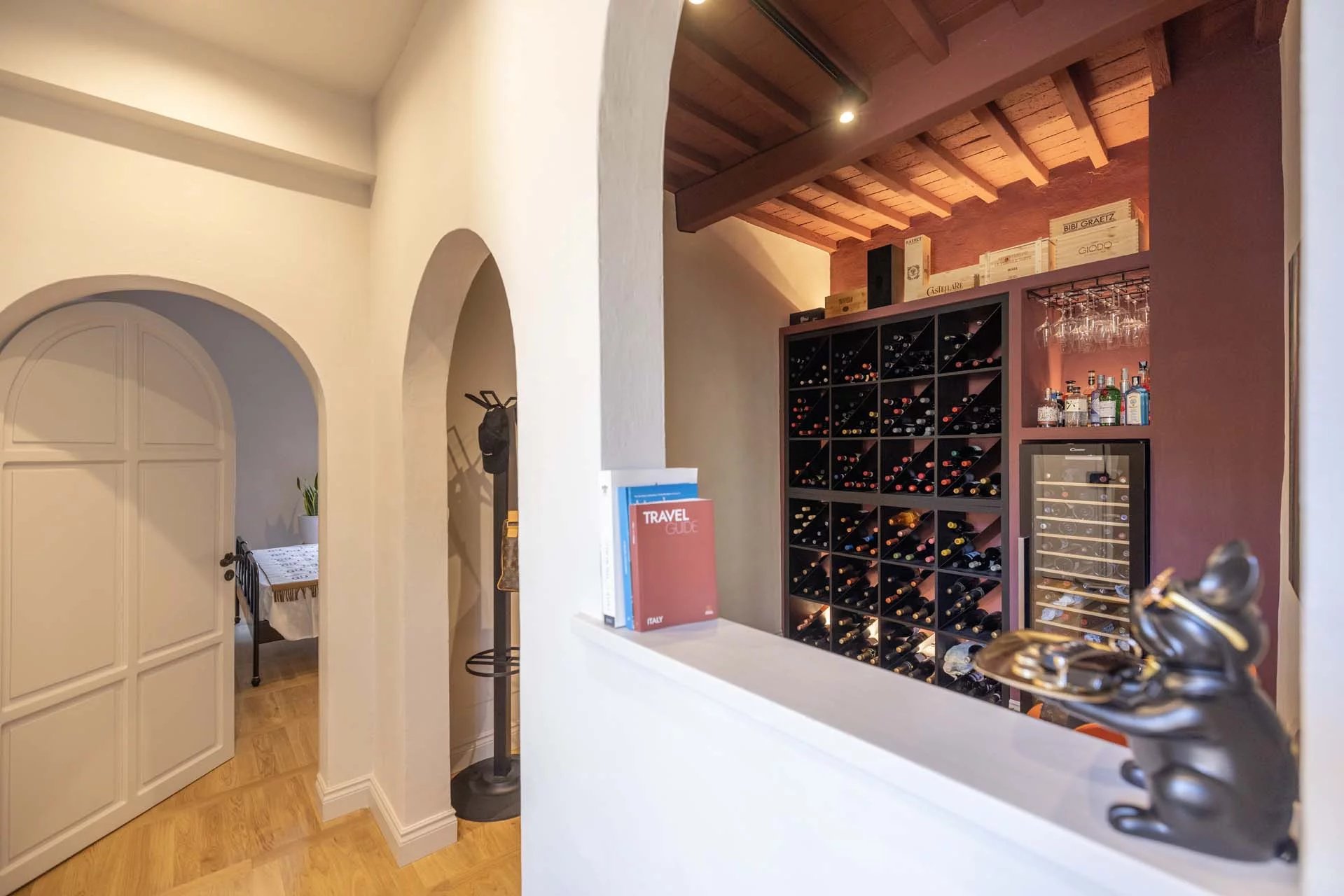
In the historic centre of Arezzo, Canto dei Bacci offers a compact, contemporary interpretation of the private wine room. Located near the entrance to the apartment, it appears in the gallery as an intimate space, with one wall entirely lined with wine bottles and two chairs.
Rather than being hidden away in a service area, the wine room is a visible feature of the home. Renovated in 2024, the 185-sqm apartment occupies part of the historic Palazzo dei Bacci and has been designed to integrate the collection into its principal living spaces.
This model is ideal for those who want to keep their wines close at hand without dedicating an entire room to a traditional cellar. Its proximity to the living area makes serving convenient, while the display itself becomes part of the interior design.
Villa d’Epoca Perugia: a dedicated room on the basement level
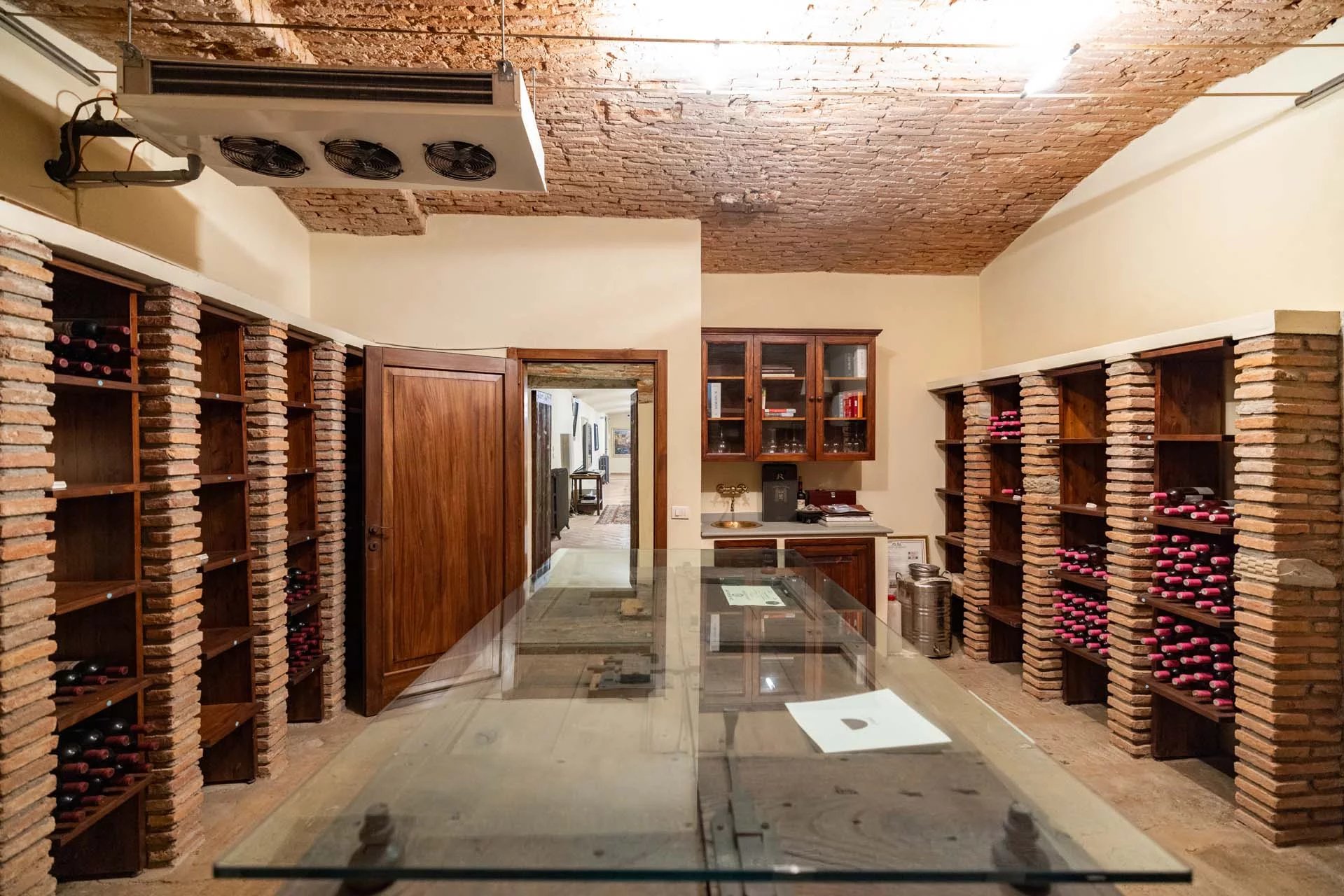
The wine cellar at Villa d’Epoca Perugia offers a more traditional interpretation. Stairs from the kitchen lead down to the basement, where a large room has been restored and converted into a private cellar.
The photographs show walls fitted with racks holding numerous bottles, together with a long central table. The room is intended for more than storage: it provides a place to browse the collection, prepare a selection or host a private tasting.
Its basement location also provides an architectural setting suited to its purpose. Substantial masonry walls, controlled lighting and separation from the home’s busiest areas help create an intimate space entirely devoted to wine.
Villa Francesca: a cellar for approximately 3,000 bottles
In the hills surrounding Florence, Villa Francesca offers the largest of the three solutions. On the basement level, beside the professional kitchen and reception room, is a ventilated wine cellar with a dedicated tasting area, designed to hold approximately 3,000 bottles.
The gallery clearly shows the racks already filled with the collection. The cellar’s position is particularly practical, allowing wines to be selected and served without passing through the villa’s private rooms—an advantage for both family dinners and larger receptions.
Here, the cellar becomes a fully integrated part of how the residence functions, proportionate to both the importance of the collection and the property’s strong vocation for entertaining.
Where to build a private cellar in a house
A basement or semi-basement often constitutes the most natural solution but is not essential. Even an internal room, a passage area little exposed to light or a portion of the living area can become a wine room, provided they are properly insulated and climate-controlled.
The ideal location should be away from:
- walls strongly exposed to the sun;
- boiler rooms and other heat sources;
- washing machines, elevators and equipment producing vibrations;
- frequently opened doors toward the outside;
- inadequately insulated kitchens;
- garages subject to large temperature swings.
Proximity to the kitchen or dining room remains an advantage. The best project finds a balance between bottle protection and practical use.
© Romolini Immobiliare
Temperature, humidity and light
Wine needs above all stability. According to the Australian Wine Research Institute, it is appropriate to store it in a cool environment, about between 15 and 20 °C, avoiding both prolonged heat and continuous temperature fluctuations.
In a fine private cellar, it is therefore not sufficient to install a normal domestic air conditioner. Adequate insulation, condensation control, a sealed door and a system designed specifically to maintain constant internal conditions are needed.
Humidity must also be monitored. A value near 70% helps preserve corks, while too high levels can encourage mold and damage labels.
Direct natural light must be limited. For artificial lighting, low heat emission sources are preferable, possibly controlled by sensors, so they remain on only when the cellar is in use. Continuous vibrations and mechanical noises should also be reduced as much as possible.
© Romolini Immobiliare
Shelves and wine room organization
Furniture must be chosen based on the weight they must support and the environment's humidity conditions. Treated wood, painted metal and stone can be combined provided they do not emit odors and allow proper air circulation.
For bottles sealed with cork stoppers, the horizontal position keeps the wine in contact with the cork. It is also useful to provide distinct compartments for:
- standard format bottles;
- magnums and large formats;
- champagne;
- original cases;
- ready-to-drink wines;
- bottles to be aged;
- particularly rare or high-value labels.
The most scenic shelves can be reserved for a limited selection, while the rest of the collection should favor accessibility and order. A small resting surface is precious even in compact cellars; in larger environments it can become a real tasting table.
For important collections, it is advisable to complement the physical arrangement with a digital inventory, recording position, vintage, quantity and ideal consumption window for each bottle.
What to check when visiting a property with a cellar
Photos allow understanding if the space exists and is really used, but during the visit it is necessary to check even the less visible aspects:
- presence of a dedicated air conditioning system;
- actual temperature and humidity recorded;
- any traces of condensation, infiltration or mold;
- quality of insulation and the door;
- noises or vibrations produced by nearby systems;
- actual shelf capacity;
- space still available to expand the collection;
- ease of access to kitchen and dining room;
- alarm, security and remote monitoring systems;
- assistance planned in case of power outage.
A well-done private cellar is not the most spectacular room in the house, but the one where technology, collection and conviviality find the same balance. It protects bottles without hiding them and accompanies a simple gesture: choosing a wine, opening it and bringing it to the table. It is this continuity between storage and domestic life that transforms a wine room into an authentic part of the residence.


Copyright ©2026 Romolini

